
How Much Does a Ford F-150 Weigh?
Curious how much your next truck really weighs? It's a fair question — one that our team at Mike Castrucci Ford in Milford, Ohio, hears all the time from folks cross-shopping trims and engines. F-150 weight isn't just a number on a window sticker; it shapes how the truck tows, hauls, and handles on the daily commute or the job site. So let's break it down in plain terms.
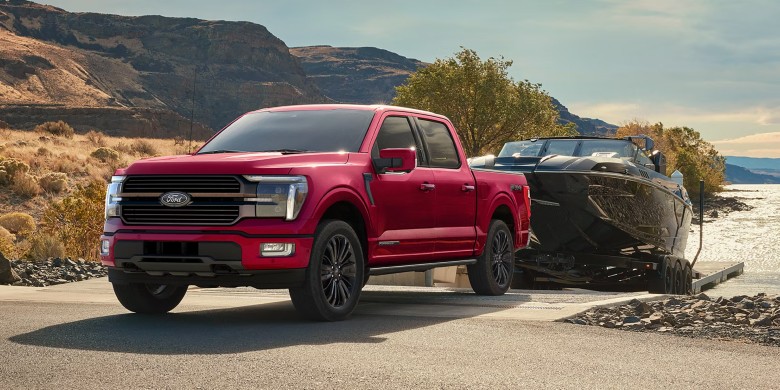
Key Takeaways
- Ford F-150 curb weight generally runs from about 4,000 to nearly 6,000 pounds, depending on cab, engine, and trim.
- Cab style matters — Regular Cab models are the lightest, SuperCrew models are the heaviest.
- Engine choice shifts the scale — the 2.7L EcoBoost keeps things lighter, while the 3.5L PowerBoost hybrid and 5.2L supercharged V-8 add pounds.
- Payload capacity is essentially GVWR minus curb weight, and it can top 2,400 pounds on the right configuration.
- The exact number for any specific truck is printed right on the driver's door safety label.
How Much Does a Ford F-150 Weigh?
A Ford F-150's curb weight typically falls between roughly 4,000 and 5,950 pounds. That's the truck with a full tank of gas and all standard equipment, but no passengers or cargo on board. Where a specific truck lands in that range depends on cab size, drivetrain, and engine.
The lightest configurations are Regular Cab models with two-wheel drive and a smaller engine — some XL builds check in right around 4,000 to 4,400 pounds. Step up to a SuperCrew cab with four-wheel drive, and the F-150's weight climbs toward 5,300 to 5,500 pounds. Add a performance-oriented trim like the Raptor, with its wider stance and reinforced suspension, and the curb weight can approach 6,000 pounds. None of this is guesswork on the dealership's end, either — every F-150 leaves the factory with its exact curb weight and gross vehicle weight rating stamped on a label inside the driver's door.
Quick Reference: Curb Weight by Configuration
- Regular Cab, 2WD, smaller engine: roughly 4,000–4,400 lbs
- SuperCab, mid-range engine: roughly 4,500–5,000 lbs
- SuperCrew, 4WD, larger or hybrid engine: roughly 5,300–5,950 lbs
What Affects a Ford F-150's Weight?
Three things move the needle most: cab configuration, engine choice, and drivetrain. Add four-wheel drive, a bigger cab, or extra hardware, and the truck gets heavier — plain and simple.
Cab size is the biggest factor. A Regular Cab is built for two, with a shorter footprint and less structure to haul around, so it naturally weighs less than a SuperCrew, which adds a full back seat and more sheet metal. Engine choice matters just as much. The 2.7L EcoBoost V6 is the lightest option in the lineup, built for efficiency. The 5.0L V-8 and 3.5L EcoBoost V6 add muscle — and pounds — for serious towing. The 3.5L PowerBoost hybrid tacks on extra weight from its battery pack, while the supercharged 5.2L V-8 in the Raptor is the heaviest engine offered. Four-wheel drive systems add weight, too, thanks to the transfer case and extra driveline components. Understanding the F-150's weight this way makes it easier to choose a build that matches how the truck is actually used.

This table helps customers compare how each factor shifts the F-150's weight at a glance.
| Factor | Impact on Weight | Example |
|---|---|---|
| Cab style | Bigger cabs add structure and seating, increasing curb weight. | SuperCrew vs. Regular Cab: a difference of 1,000+ lbs. |
| Engine | Larger or hybrid engines add mass; smaller EcoBoost engines stay lighter. | 2.7L EcoBoost vs. 5.2L supercharged V-8. |
| Drivetrain | 4WD adds a transfer case and driveline hardware. | 4x4 typically weighs more than the same trim in 4x2. |
| Trim/package | Off-road or luxury packages add reinforced parts and features. | Raptor's skid plates and suspension add pounds over XLT. |
| Bed length | Longer beds mean more steel, adding modest weight. | 8-ft box vs. 5.5-ft box on the same cab. |
How Does F-150 Weight Affect Towing and Payload?
Weight and capability go hand in hand. A heavier F-150 with the right engine can often tow and haul more, but curb weight also reduces the remaining payload.
Payload capacity is simply the gross vehicle weight rating minus the truck's curb weight — so a lighter truck doesn't automatically mean more room to carry cargo. A well-equipped F-150 can carry over 2,400 pounds of payload and tow up to 13,500 pounds when properly configured, figures that depend heavily on engine and axle ratio. Drivers hauling campers, boats, or job-site equipment regularly should pay close attention to the F-150 weight rating on their specific build rather than assuming every F-150 tows the same. Overloading a truck — even by a few hundred pounds — puts extra strain on brakes, suspension, and tires, and it's not something to guess at. The safety label on the driver's door and the owner's manual both spell out the exact numbers for that particular truck.
The Bottom Line on F-150 Weight
At the end of the day, there's no single answer to how much an F-150 weighs — it depends on the cab, the engine, and how the truck is built. That's exactly why it pays to talk through the details with someone who knows the lineup inside and out. Whether it's a work truck that needs serious towing muscle or a comfortable daily driver, our team at Mike Castrucci Ford in Milford can match the right configuration to the job, and explain how F-150 weight factors into the decision along the way.
Wondering how a specific F-150 on the lot stacks up? Stopping by Mike Castrucci Ford in Milford is an easy way to see the door label numbers in person and get honest answers about towing, payload, and trim differences. Our service team is also on hand for anything from routine maintenance to questions about how a truck's weight affects tire wear and brake life over time.

FAQ
How much does a Ford F-150 weigh on average?
Most F-150 configurations land somewhere between 4,300 and 5,700 pounds, with the lightest Regular Cab models and the heaviest SuperCrew or off-road trims sitting at either end of that range.
Where can I find the exact weight of my F-150?
Check the safety compliance label on the driver's-side doorjamb — it lists the truck's curb weight, gross vehicle weight rating, and payload capacity for that specific build.
Does a heavier F-150 tow more?
Not necessarily. Towing capacity depends more on engine, axle ratio, and available towing packages than on curb weight alone, though heavier trims often pair with stronger drivetrains.
What's the difference between curb weight and GVWR?
Curb weight is the truck's weight with fluids and no cargo, while GVWR (gross vehicle weight rating) is the maximum allowable weight, including passengers, cargo, and accessories.
Which F-150 engine keeps the curb weight the lowest?
The 2.7L EcoBoost V6 is generally the lightest engine in the F-150 lineup, making it a popular choice for buyers seeking a good balance of efficiency and capability.
Can I see the F-150 weight specs in person at Mike Castrucci Ford?
Absolutely. Stop by the Milford showroom, and a member of our team can walk through door-label specs on in-stock trucks and help match a configuration to specific towing or payload needs.